In the AI & Database Lab (AIDBL) in the Department of Data Science, Musashino University, we conduct research on AI algorithms and databases, which form the core of modern information systems.
武蔵野大学 データサイエンス学科 AI・データベース研究室(AIDBL)では、情報システムの中核である人工知能(AI)アルゴリズム、データベースの研究を行っています。
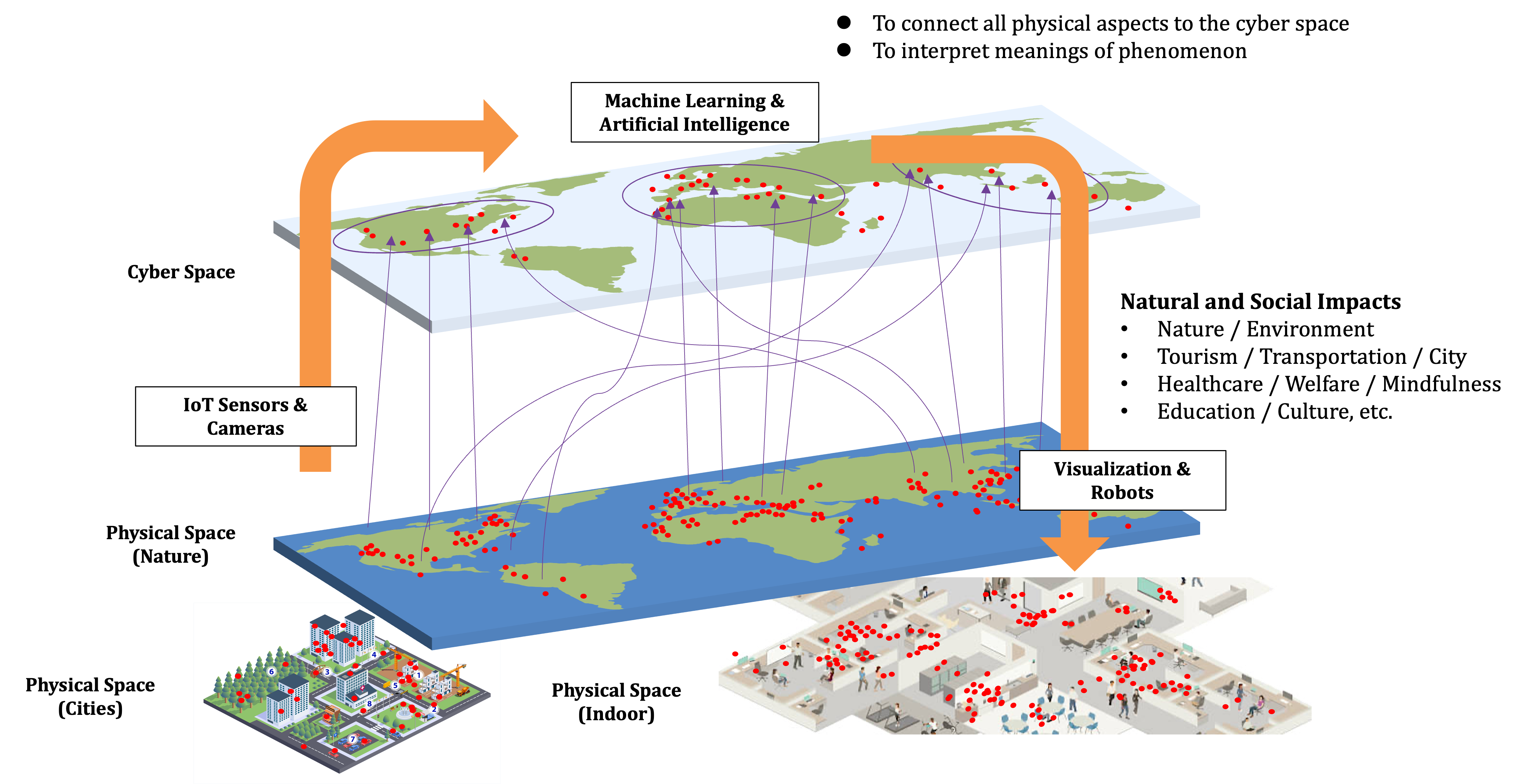
Find Out More About AIDBLIn our everyday lives, a wide variety of computers—such as sensors, cameras, smartphones, displays, and robots—are ubiquitous and interconnected through networks. In addition, AI algorithms are deployed as core computations to perform analysis, prediction, inference, and optimization.
As a result, a cyber–physical space is formed that extends the physical world into a computable space, enabling problem solving and new value creation in concrete domains such as transportation, tourism, welfare, natural environment, and learning. This integrated space represents a new frontier for humanity.
Our laboratory conducts research on this integrated cyber–physical space, focusing on:
私たちの身の回りには、センサ、カメラ、スマートフォン、ディスプレイ、ロボットなど多様なコンピュータが存在し、ネットワークによって相互に接続されています。さらに中核計算として、解析・予測・推定・最適化などを行うAIアルゴリズムが適用されます。
その結果、物理空間を「計算可能な空間」へ拡張するサイバー・フィジカルスペースが形成され、交通・観光・福祉・自然環境・学習といった具体領域(ドメイン)における課題解決や新たな価値創造が可能となっています。この融合空間は人類にとって新たなフロンティアです。
本研究室は、サイバーとフィジカルの融合空間を対象として、次の研究に取り組みます。
In advancing our research, we clarify the following perspectives and explore them through iterative cycles of discussion and implementation.
研究を進めるにあたり、本研究室は次の観点を明確化し、議論と実装を反復しながら探求します。
Necessity of Designing Original Core Computations 独自の中核計算の設計の必要性
When applying standard AI algorithms, discussion often tends to focus on improving accuracy by increasing the quantity and quality of training data or by switching among model families. However, when viewed in light of a domain’s goals, the essential questions are different: Is the computational model appropriate? Is the computation itself semantically valid? Are the decisions explainable? How can constraints, context, and safety be incorporated? How can black-box behavior be avoided? Applying existing methods is only a starting point for problem solving; new value creation becomes possible only when you design original core computations that are aligned with the intended purpose.
代表的なAIアルゴリズムの適用では、学習データの量や質、計算モデルの違いによる精度向上に議論が偏りがちです。しかし具体領域の目的に照らすと、計算モデルは妥当か、計算自体の意味的な妥当性、判断結果の説明可能性、制約・文脈・安全性をどう組み込むか、ブラックボックス化をどう回避するかが本質となります。既存手法の適用は課題解決の出発点に過ぎず、目的に整合した独自の中核計算を設計してはじめて、新たな価値創造が可能となります。
What Is a System Architecture? システムアーキテクチャとは
A system architecture is a design principle that defines the elements constituting a system (modules, data, computation, inputs/outputs, communication) and specifies their relationships, boundaries, and responsibilities so that the system as a whole achieves its objectives. At its core is making explicit the correspondence between data structures (operands) and algorithms (operators)—that is, specifying which data are transformed by which procedures and how.
Moreover, it provides a framework in which complex processes are decomposed hierarchically into isomorphic subproblems, and the same function (procedure) is invoked recursively, thereby extending local computational rules consistently to the overall computation. Therefore, rather than designing ad hoc solution functions for each individual problem, it is essential to design an original data model and core computation that align with the domain’s objectives and reflect its constraints and context.
システムアーキテクチャとは、システムを構成する要素(モジュール、データ、計算、入出力、通信)と、それらの関係・境界・責務を定義し、全体として目的を達成するための設計原理です。中核は「データ構造(オペランド)」と「アルゴリズム(オペレータ)」の対応を明確化し、どのデータをどの手続きで変換するかを規定する点にあります。
さらに、複雑な処理を同型の部分問題へ階層的に分解し、同一の関数(手続き)を再帰的に呼び出すことで、局所の計算規則を全体の計算へ一貫して拡張する枠組みを与えます。したがって、個別課題ごとに解法関数をアドホックに設計するのではなく、具体領域の目的に整合し、制約・文脈を反映した独自のデータモデルと中核計算を設計することが不可欠です。
What Is a Knowledge Base? 知識ベースとは
A knowledge base is an information resource that systematizes expert knowledge—such as concepts, definitions, causal relationships, procedures, constraints, and context—into forms that computers can reference, reason over, and verify (e.g., ontologies, knowledge graphs, rules, constraint specifications, probabilistic models).
Unlike approaches such as neural networks that learn regularities from large-scale data and form internal representations (implicit knowledge), a knowledge base makes explicit what counts as knowledge and enables the rationale and meaning to be traceable. This makes it possible to design core computations that balance data-driven inference with goals, constraints, safety, and explainability.
知識ベースとは、専門家が持つ概念・定義・因果関係・手順・制約・文脈などの知識を、計算機が参照・推論・検証できる形(例:オントロジ、知識グラフ、ルール、制約条件、確率モデル)で体系化した情報資源です。
ニューラルネットワークのように大量データから規則性を学習して内部表現(暗黙知)を形成する方法と異なり、知識ベースは「何を知識とみなすか」を明示し、根拠や意味を追跡可能にします。これにより、データ駆動の推定と、目的・制約・安全性・説明可能性を両立させる中核計算の設計が可能となります。
Difference Between Problem Solving and New Value Creation 課題解決と新たな価値創造の違い
Problem solving is the practice of identifying phenomena that are shared within a domain as “problems,” analyzing their causes, and providing solutions within the existing framework of goals, constraints, and evaluation criteria. In other words, it focuses on resolving what practitioners already recognize as issues.
By contrast, new value creation begins by articulating a desirable future state (a vision) and reasoning backward from it to question the underlying “taken-for-granted” assumptions and common sense that frame the problem—such as goal setting, operational procedures, decision-making mechanisms, and modes of delivery. As needed, it also incorporates methods and technologies from other domains to redesign the rules and experiences of the domain. As a result, it goes beyond incremental improvement and can potentially transform the domain itself.
課題解決とは、ある領域で「問題」として共有されている事象を特定し、原因を分析して、既存の目標・制約・評価基準の枠内で解を与える営みです。すなわち、現場が課題と認識しているものを、解くことに主眼があります。
これに対し新たな価値創造とは、将来のあるべき姿(ビジョン)を描き、そこから逆算して、課題の前提となっている「当たり前」や「常識」(目的設定、業務手順、意思決定の仕組み、提供形態)そのものを問い直す営みです。必要に応じて他領域の方法や技術も取り込みながら、領域のルールや体験を再設計します。結果として、改善にとどまらず、領域全体を新しく作り変える可能性を含みます。
Why Interdisciplinarity Is Necessary 学際の必要性
Modern global challenges consist of interdependent factors spanning society, the environment, and technology; thus, understanding the whole picture and designing effective interventions are difficult using the knowledge or methods of a single discipline alone.
Accordingly, an interdisciplinary approach is required—one that defines problems across data science, engineering, the social sciences, and the humanities, and constructs solutions that integrate evaluation criteria, constraints, and stakeholders’ values.
Furthermore, emerging technologies such as AI, IoT, and digital twins stand at the forefront of this transformation. You must understand both the solutions enabled by these technologies and their societal impacts. In addition, to implement advanced solutions in society, it is essential to integrate technology into marketing strategies (e.g., value propositions, adoption design, diffusion models).
現代のグローバル課題は、社会・環境・技術にまたがる相互依存的な要因から構成され、単一分野の知識や方法だけでは全体像の把握と有効な介入設計は困難です。
したがって、データ科学、工学、社会科学、人文知を横断して課題を定義し、評価基準や制約、利害関係者の価値を統合した解決策を構築する学際的アプローチが求めらます。
さらに、AI、IoT、デジタルツインなどの新興技術は、この変革の最前線に位置し、解決策そのものと社会への影響の両面を理解する必要があります。加えて、先進的解決策を社会実装するには、技術をマーケティング戦略へ統合する視点が不可欠です。
Difference Between a Computational Method and System Implementation 計算方式とシステム実装の違い
A computational method is a design that defines the principles of computation: which algorithms (operators) are applied to which data structures (operands), and what is to be inferred, predicted, or optimized.
By contrast, system implementation is the work of concretizing that computational method by integrating software, data infrastructure, and devices so that it operates under real-world constraints (performance, reliability, security, operations, UI, communication).
計算方式とは、データ構造(オペランド)に対してどのアルゴリズム(オペレータ)を適用し、何を推定・予測・最適化するかという「計算の原理」を定める設計です。
一方、システム実装とは、その計算方式を現実の制約(性能、信頼性、セキュリティ、運用、UI、通信)下で動作させるために、ソフトウェア・データ基盤・デバイスを統合して具体化する作業です。
Effectiveness and Feasibility 有効性と実現可能性
Effectiveness is the extent to which a proposed method actually produces benefits for the specified objectives and tasks, demonstrating more desirable results than existing methods. Improvements are confirmed through evaluation metrics (accuracy, error, cost, time, user satisfaction, etc.).
Feasibility is the extent to which a proposed method can realistically be implemented and operated under practical constraints (data availability, computational resources, operational load, regulations, security, accountability, etc.). Even if a method is theoretically possible, feasibility is low if the required conditions are excessive.
有効性は、提案手法が、設定した目的・課題に対して実際に効果を生み、既存手法より望ましい結果を示す性質です。評価指標(精度、誤差、コスト、時間、満足度など)により、改善が確認できることを指します。
実現可能性は、提案手法が、現実の制約(データ入手性、計算資源、運用負荷、法規制、セキュリティ、説明責任など)を踏まえて、実装・運用できる見込みがある性質です。理論上可能でも、必要条件が過大なら実現可能性は低くなります。
Through the Future Creation Project and our regular courses, the lab provides students with systematic training in how to design original core computations, system architectures, and knowledge bases, as well as how to conduct research in practice. We also emphasize the necessity of interdisciplinary thinking and the knowledge, skills, and mindsets required to turn ideas into real-world implementations.
Within the cyber–physical space—a new frontier for humanity—we cultivate data scientists and data engineers who can explore original core computations, develop AI systems, and drive new value creation.
本研究室では、未来創造プロジェクトと通常科目を通じて、独自の中核計算、システムアーキテクチャ、知識ベースの設計方法、研究実践方法、学際の必要性、必要とされる知識・技能・マインドセットについて履修者に提供します。
私たちはサイバー・フィジカルスペースという人類にとって新たなフロンティアにおいて、独自の中核計算の探求、AI開発を行えるデータ科学者、データ技術者を育成します。
The Future Creation Project (PJ) is a research-practice program that starts in the fall semester of the first year. Participants define their own research themes and, as needed, take regular courses in parallel to deepen and advance their projects.
未来創造PJは、1年生秋学期からスタートする研究実践です。 履修者は自ら研究テーマを設定し、必要に応じて通常科目を履修しながら研究内容を深化させて行きます。
Plans & Goals 計画と目標
Year 1: Foundation Building & Research Theme Setting
1年次: 基礎構築と研究テーマの設定
Year 2: Model Development & Prototyping
2年次: モデル開発とプロトタイピング
Year 3: Model Refinement & Research Expansion
3年次: モデルの改良と研究の拡大
Year 4: Research Completion & Real-World Application
4年次: 研究の完了と実世界への応用
Required Knowledge, Skills, and Mindsets 必要とされる知識・技能・マインドセット
To realize ideas, it is necessary not only to generate original concepts but also to translate them into a computable form, validate them, and connect them to real-world deployment—requiring the appropriate knowledge, skills, and mindset.
In this lab, we build this foundation through conceptual and logical design, databases and SQL, and programming, while cultivating rigorous mathematical modeling grounded in mathematics, statistics, and optimization. We also emphasize implementation capability that extends beyond software to include sensors, networks, servers, and actuators, thereby enabling robust connections between cyber and physical worlds.
In addition, we foster an attitude of questioning goals, meanings, and concepts from a philosophical perspective. Rather than merely following existing methods, intellectual curiosity to design original core computations that fit a domain’s objectives, constraints, and context is indispensable. Our guiding principle is to keep learning proactively and to realize ideas through collaboration with others.
アイディアを実現するには、独自の発想に加えて、それを「計算可能な形」に落とし込み、検証し、社会実装につなげる知識・技能・マインドセットが必要となります。
本研究室では、概念設計・論理設計、データベースとSQL、プログラミングを基盤に、数学・統計・最適化による数理的モデル化の力を養います。さらに、ソフトウェアに加えてセンサ、ネットワーク、サーバ、アクチュエータまで含む実装力を重視し、サイバーとフィジカルの接続を実現します。
加えて、哲学的視点から目的・意味・概念を問い直す姿勢を育みます。既存手法をなぞるのではなく、領域の目的・制約・文脈に適合した独自の中核計算を設計しようとする探究心が不可欠です。自ら学び続け、他者と協働しながらアイディアを実現していくことを基本姿勢とします。
Data Science Literacy
Data Science
Database, SQL, PL/SQL
Discrete Mathematics, AI Algorithm, Machine Learning
Web Technology, Network, Security, Deployment
Multimedia, Spatio-Temporal Data, Knowledge Bases, Data Mining
Semantic Computing, Artificial Intelligence, Machine Learning, Deep Learning
Cyber-Physical System, IoT Sensing, Actuator, Time Series Data
AI Society, Data Science, Generative AI, Medical AI
Data Science, Artificial Intelligence, Semantic Computing
Multimedia, Spatio-Temporal Data, Knowledge Bases, Data Mining
Cyber-Physical System, IoT Sensing, Actuator, Time Series Data